XPS or PUR? How to Choose the Right Core for a Sandwich Panel
The core is the invisible part of a sandwich panel, yet it is largely responsible for the panel’s performance. It determines thermal insulation, mechanical strength, compressive resistance, and how the panel performs under specific operating conditions.
One of the most common questions when designing sandwich panels is whether to choose XPS (extruded polystyrene) or PUR (polyurethane foam) as the insulation core. Both materials are widely used across various industries, but each has been developed to meet different technical requirements.
In this article, we explain the key differences between these two core materials and help you determine which one is the better choice for your application.
What Is a Sandwich Panel Core?
A sandwich panel consists of two outer facings with an insulating core bonded between them. Depending on the application, the facings may be made of HPL, aluminium, PVC, GFRP (glass fibre reinforced plastic), or steel, while the core provides the panel with its thermal insulation and mechanical performance.
Selecting the right core should always be based on the intended operating conditions of the finished panel, including temperature range, moisture exposure, mechanical loads, and thermal insulation requirements.
XPS – Durability and Moisture Resistance
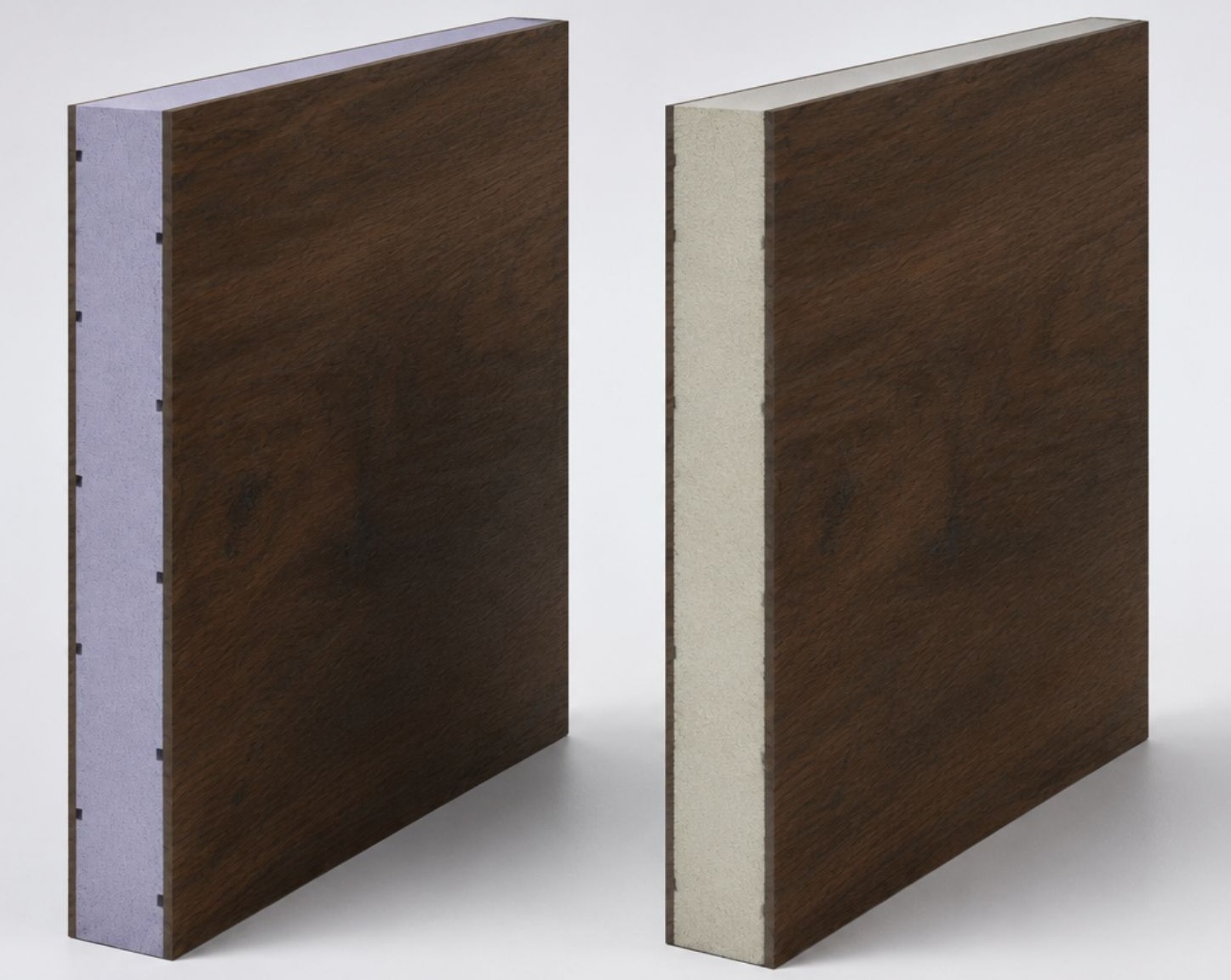
XPS (extruded polystyrene) is a closed-cell insulation material known for its extremely low water absorption and excellent dimensional stability.
The natural colour of XPS is white. The coloured XPS boards available on the market obtain their appearance from pigments added by individual manufacturers. The colour has no effect on the material’s technical performance.
As standard, XPS boards feature a grooved surface that improves adhesion during the bonding process. For thicknesses below 8 mm, or upon customer request, smooth (non-grooved) versions are also available.
Key properties of XPS:
- Density: approximately 33 kg/m³
- Thermal conductivity (λ): approximately 0.034 W/mK
- Compressive strength: 200–300 kPa (higher grades are also available)
- Operating temperature range: -50°C to +75°C
- Fire reaction class: Class E according to EN 13501-1
Thanks to its excellent moisture resistance and strong mechanical properties, XPS is frequently used in applications exposed to changing environmental conditions.
PUR – Superior Thermal Insulation with Reduced Thickness
PUR (polyurethane foam) is primarily valued for its excellent thermal insulation performance. Its lower thermal conductivity means that, at the same thickness, PUR provides better insulation than XPS.
PUR has a characteristic light yellow colour and is typically supplied with a smooth surface. If required, grooved versions are also available.
Key properties of PUR:
- Density: 35–50 kg/m³
- Thermal conductivity (λ): approximately 0.022 W/mK
- Compressive strength: approximately 190–400 kPa (depending on density)
- Operating temperature range: -70°C to +120°C
- Fire reaction class: Class E or F according to EN 13501-1
Its excellent thermal insulation allows high insulation performance to be achieved even with relatively thin sandwich panels.
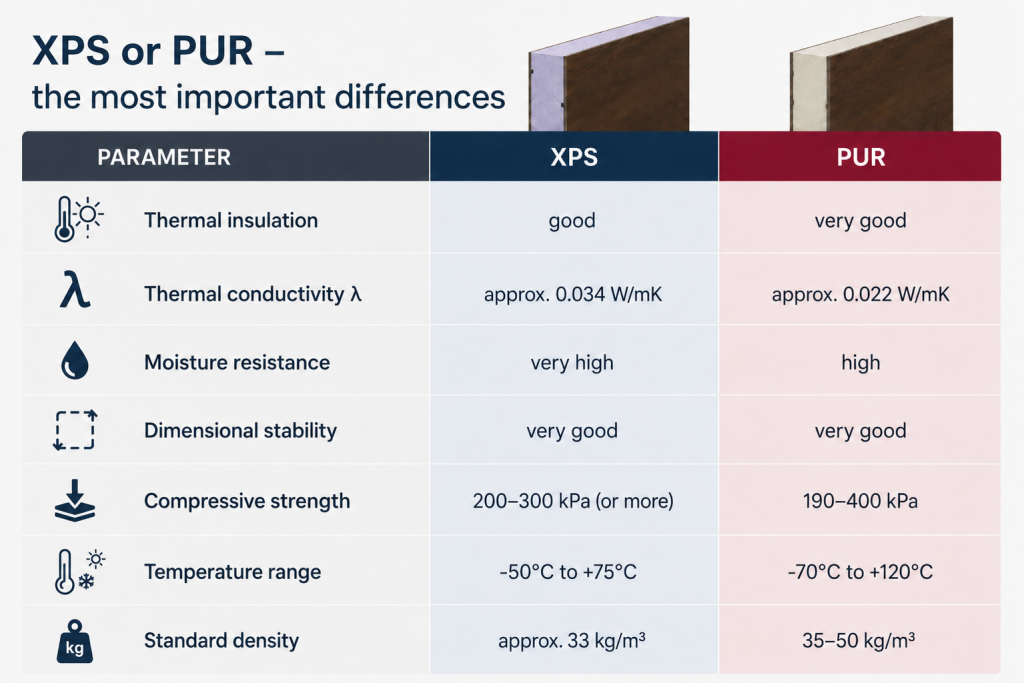
Although both materials perform similarly in many areas, the most significant difference lies in their thermal insulation. PUR provides better protection against heat loss, while XPS offers outstanding moisture resistance and an excellent balance between performance and cost.
When Should You Choose XPS?
XPS is the preferred choice wherever moisture resistance, dimensional stability, and good mechanical strength are essential.
It is commonly used in:
- Door infill panels
- Refrigeration and cold room panels
- Transport body applications
- Signage and advertising panels
- Structures operating in high-humidity environments
In many applications, XPS provides the optimal solution when durability and cost-effective performance are the main priorities.
When Is PUR the Better Choice?
PUR should be considered when the primary objective is to achieve the highest possible thermal insulation or when panel thickness is limited.
Typical applications include:
- Air handling units (AHUs)
- HVAC systems
- Technical and process chambers
- Specialist equipment enclosures
- Structures operating across a wider temperature range
Its lower thermal conductivity makes it possible to achieve excellent insulation performance without increasing the overall panel thickness.
Common Mistakes When Selecting a Core Material
Choosing a core material based solely on price can result in long-term performance issues. Another common mistake is selecting a material based only on its thermal conductivity (λ-value) without considering the operating conditions of the finished panel.
Before making a decision, ask the following questions:
- What temperature range will the panel operate in?
- Will it be exposed to moisture?
- What mechanical loads will it be required to withstand?
- Is maximum thermal insulation the key requirement?
- Are there any limitations on the overall panel thickness?
Answering these questions will help you select the material best suited to your project’s specific requirements.
Does the Colour of the Core Matter?
This is one of the questions we are asked most frequently.
The colour of an insulation core does not indicate its quality or technical performance. In the case of XPS, the colour is simply determined by the manufacturer and has no effect on the material’s functional properties.
Far more important are characteristics such as density, thermal conductivity, compressive strength, and temperature resistance.
Panel Performance Depends on More Than Just the Core
Although choosing between XPS and PUR is an important decision, the overall performance of a sandwich panel also depends on the facing materials and the manufacturing process.
The type of facings, bonding technology, manufacturing quality, and production precision all have a direct impact on the panel’s durability, rigidity, and long-term reliability.
For this reason, the insulation core should always be considered as one element of the complete panel design, rather than the sole factor determining the quality of the finished panel.
Conclusion
There is no universally superior material. Both XPS and PUR have their own strengths and are designed for different applications.
If your priority is excellent moisture resistance, good mechanical strength, and the best balance between performance and cost, XPS is an excellent choice.
If, however, your project requires superior thermal insulation, reduced panel thickness, or reliable performance across a wider temperature range, PUR is the better solution.
The best results are achieved when the insulation core is selected according to the specific requirements of the application, taking into account the facing materials, operating conditions, and the required performance of the finished sandwich panel.
Polecane wpisy
-
HPL, GFK/ GFRP/ FRP, PVC, Aluminium or Steel – How to Choose the Right Facing for a Sandwich Panel?
When designing a sandwich panel, it is easy to focus on the core thickness or…
-

Why Do Modern Door Panels Place Increasing Demands on Sandwich Panels?
For many years, the construction of sandwich panels used in entrance doors was based on…
-
LB THERM Expands Its Distribution Network Across the Baltic States
We are consistently strengthening our presence in international markets. As part of this strategy, we…